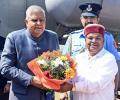
Karnataka Governor Thaawarchand Gehlot has reserved the Bill pertaining to four percent reservation for Muslims in government contracts for the President's assent, citing constitutional concerns. The Bill, which has been a subject of controversy in Karnataka, was passed by both houses of the state legislature amid protests from the opposition BJP. The Governor's decision to reserve the Bill highlights the ongoing debate over the constitutionality of religious-based reservations in India.
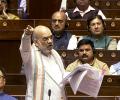
Home Minister Amit Shah stated in the Rajya Sabha that the terrorists responsible for the Pahalgam attack were killed in Operation Mahadev. He also criticized the Congress party's stance on national security.

Some of the issues Vivek Agnihotri raises in The Bengal Files are valid, but today, the need of the hour is to find ways of negotiating peace not pouring oil over troubled waters, asserts Deepa Gahlot.
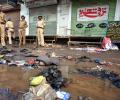
Nearly 17 years after a blast in Malegaon town of north Maharashtra claimed six lives, a special court in Mumbai on Thursday acquitted all the seven accused, including former Bharatiya Janata Party MP Pragya Singh Thakur and Lieutenant Colonel Prasad Purohit, noting there was 'no reliable and cogent evidence' against them.

Yogi said Waqf boards have become a den of selfish interests as well as loot khasot (property grabbing), and have done little for the welfare of Muslims.
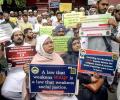
'The new Waqf bill sows the seed for conflict in every town and village of India.'

Members of Hindu right-wing outfits allegedly created ruckus at a mausoleum in Fatehpur district in Uttar Pradesh, demanding permission to offer prayers and claiming a temple had previously existed at the site. The incident has led to heightened security and political reactions.

Prime Minister Narendra Modi on Thursday attacked the Congress over party president Mallikarjun Kharge's recent remark on Lord Ram and Lord Shiva, and accused the opposition party of trying to divide Hindus for its appeasement politics.

Prime Minister Narendra Modi on Monday accused the Congress again of planning to redistribute people's property if it is voted to power, but stopped short of saying that the wealth would go to Muslims.

Rashtriya Janata Dal president Lalu Prasad Yadav on Tuesday said he was in favour of extending reservation benefits to Muslims but emphasised that it should be based on social backwardness and 'not on the basis of religion'.

'Till now, many political parties indulged in Muslim appeasement.' 'This is one experiment, successfully carried out by the AAP, in indulging in Hindu appeasement.'

Bihar MP Pappu Yadav said he could 'finish off within 24 hours' the network of Lawrence Bishnoi who is suspected to be behind the assassination of former Maharashtra minister Baba Siddiqui.

The massive victory of Bharatiya Janata Party-led Mahayuti in Maharashtra indicates a tactical course correction post the Lok Sabha debacle, with factors like Rashtriya Swayamsevak Sangh's active role in the poll campaign, Ladki Bahin scheme, rise in women voting, and subtle message of Hindutva playing a crucial role.
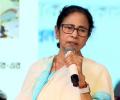
West Bengal Chief Minister Mamata Banerjee has accused the Border Security Force (BSF), central agencies, and the BJP of fanning tension in Murshidabad by allegedly facilitating cross-border influx from Bangladesh. She also urged Prime Minister Narendra Modi to keep the Union Home Ministry under control. Banerjee has announced a compensation of Rs 10 lakh each for the families of three people killed during the violence and directed the state chief secretary to initiate a probe into the role of the BSF.
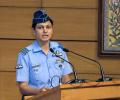
The SP MP said when the mentality is bad, then instead of telling about the achievements of the army, people start talking about their own achievements.

The situation in Muslim-dominated Murshidabad district of West Bengal, which was marred by incidents of violence following protests over the Waqf (Amendment) Act, was calm and peaceful on Wednesday with no reports of any untoward incident. Prohibitory orders were clamped in and around Raghunathganj and Suti police station areas and large police force deployed in all sensitive areas of the district, especially in and around Jangipur town, where a large number of people had assembled on Tuesday afternoon, demanding the withdrawal of the legislation. Internet connectivity remained suspended within the areas under the Jangipur sub-division to prevent the spread of any disinformation. Protestors, who had gathered in large numbers on the NH-12 in the Jangipur area to protest against the Waqf Bill, hurled stones at the police who were deployed in the area, on Tuesday afternoon. A couple of vehicles belonging to the police were allegedly torched during the protest and police had to resort to lathi-charge and use tear gas shells to bring the situation under control. A few policemen were injured in the stone pelting. Police have also detained a few people in connection with the incident. West Bengal Governor C V Ananda Bose condemned the incident and said attempts to disturb the law and order situation in the state "should be put down with an iron hand". The opposition BJP alleged that the law and order situation in the state was "crumbling" under Chief Minister Mamata Banerjee, who was busy with "minority appeasement". The Waqf (Amendment) Bill was passed by the Lok Sabha on Thursday, and by the Rajya Sabha in the early hours of Friday after marathon debates in both Houses of Parliament. The Act aims to streamline the management of Waqf properties (assets permanently donated by Muslims for religious or charitable purposes) with provisions to safeguard heritage sites and promote social welfare. It also seeks to improve governance by enhancing transparency in property management, streamlining coordination between Waqf boards and local authorities and protecting stakeholders' rights.
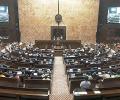
The Waqf (Amendment) Bill, 2025 was passed in the Lok Sabha early Thursday, with 288 members supporting it and 232 against it.
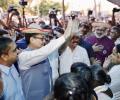
'So, they have taken away the word Waqf from the Bill.' 'It will now be known as the UMEED Act.'
In a statement, the Population Foundation of India said it is deeply concerned about recent media reports "misreporting" the findings from the study to spread alarm regarding the growth of the Muslim population in the country.
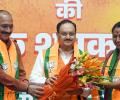
BJP president JP Nadda said on Sunday that the party does not seek to control the Waqf Board but wants to ensure that those managing it operate within the bounds of law and adhere to established rules. He said the properties and funds of the Waqf Board should be dedicated to promoting education, providing healthcare and employment opportunities for the Muslim community. Nadda also highlighted the BJP's growth and achievements, emphasizing its commitment to national unity and cultural heritage.
'The reason why Prime Minister Narendra Modi should have attended the President's iftar was not merely to break a fast with the faithful, but more importantly to broker an understanding with India's second largest set of citizens,' says Shehzad Poonawalla.

In the video, Nath is purportedly heard saying that the Rashtriya Swayamsevak Sangh and the BJP have only one message for the voters -- a vote for Narendra Modi means a vote for Hindus -- and "agar Musalman ko vote deni hai, to Congress ko vote do (vote for the Congress if you want to vote for Muslims)."
Only four working days are left for the ongoing budget session to come to an end on April 4.
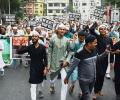
Kerala Chief Minister Pinarayi Vijayan has accused the RSS of "majority communalism" over an article published in an RSS mouthpiece regarding the Catholic Church's property holdings in India. The article, which has since been removed from the website, called for the government to acquire the church's land, claiming it was illegally leased during the British era. Vijayan said the article reveals the "true mindset" of the RSS and its alleged plan to "target minority groups one by one and destroy them step by step." The Leader of the Opposition in the Kerala Assembly, V D Satheesan, echoed Vijayan's concerns, stating that the article shows the RSS's intent to target the Church's property. He also claimed that the article's publication coincides with the passing of the Waqf Bill in Parliament, suggesting a pattern of targeting religious communities. Meanwhile, the BJP state president, Rajeev Chandrasekhar, denied the article's accuracy and stated that the article was removed after it was found to be untrue. He also emphasized that owning land is not a crime, and countered allegations that the Congress and Waqf have illegally acquired land in Karnataka. Archbishop Joseph Pamplany of Thalassery, however, expressed confidence that the Church is not afraid of any "Church Bill", as its properties have been earned through hard work. He said the Church will take legal action if necessary.

Hours after the Waqf (Amendment) Bill was passed in Parliament, 50 individuals embroiled in land disputes in Kerala's Munambam joined the BJP, hoping for a resolution to their claims. The residents, who have been protesting for 174 days, allege that the Waqf Board is claiming ownership of their properties. BJP leader Rajeev Chandrasekhar assured them of the party's support and a meeting with Prime Minister Narendra Modi to express gratitude. The BJP capitalized on the Catholic Church's support for the legislation, accusing the Congress and the Left of appeasement politics. The opposition, however, questioned the impact of the bill on the Munambam issue.

'The BJP lacks a credible mass leader who matches Mamata Banerjee's popularity.' 'Given the division of votes among Opposition parties, the West Bengal government's dole-giving strategy, and the consolidation of the poor, significant sections of scheduled caste groups and Muslim minorities behind the ruling party, it will be difficult to dislodge the Trinamool from power.'
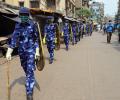
Protesters in West Bengal's Murshidabad district set fire to police vehicles and hurled stones during a demonstration against the Waqf (Amendment) Act. The incident occurred on Tuesday afternoon in the Jangipur area, where a large crowd had gathered demanding the withdrawal of the legislation. Police responded with lathi charges and tear gas to control the situation. Several people were detained and police personnel were injured in the stone-pelting. The West Bengal Police has said the situation is under control and strict action will be taken against those who resorted to violence.
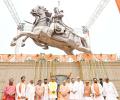
"I had said on the soil of Bahraich that glorification of foreign invaders should be stopped and that the national heroes must be honoured. And 1,000 years ago, such a tale of courage and bravery was written by Maharaja Suheldev on this very soil of Bahraich," Adityanath said.
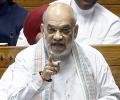
The Lok Sabha passed the Waqf (Amendment) Bill, 2025, with the ruling NDA defending it as beneficial for minorities while the opposition called it "anti-Muslim". All amendments moved by the opposition were rejected and the bill was passed with 288 votes in favor and 232 against. Union Minorities Affairs Minister Kiren Rijiju asserted that India is the safest place in the world for minorities, refuting claims of their insecurity.
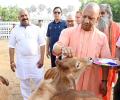
Uttar Pradesh Chief Minister Yogi Adityanath, known for his hardline Hindutva views and 'bulldozer justice' approach, has spoken out about his policies toward Muslims, the Waqf board, and his vision for India. He asserts that Muslims will receive a fair share of development in Uttar Pradesh, but not special concessions. He also criticizes the Waqf board for its alleged appropriation of government properties and calls for its reform. Adityanath defends his 'bulldozer justice' policy, claiming it is necessary for infrastructure development and removal of encroachments. He also discusses his vision for India, emphasizing the importance of Hindi as a national language and the need for unity across different linguistic groups.

Several areas in Muslim-majority Murshidabad, including Suti, Dhulian, Jangipur and Shamsherganj, have witnessed violent protests against the Waqf (Amendment) Act that spiralled into communal violence, sparking the exodus.
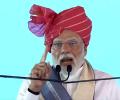
Modi alleged that the Congress government in Karnataka gave reservations in tenders based on religion, "snatching the rights of SCs, STs and OBCs." But Ambedkar had said there would not be reservation based on religion and there is a bar on giving reservation on the basis of religion in the Constitution, he stressed.

He said the then prime minister Manmohan Singh had given a speech in which he had said Muslims have the first right to the country's resources.

'I don't think the state administration has shown the resolve to enter Muslim neighbourhoods and arrest offenders in the last decade.'

Bharatiya Janata Party's national spokesman and veteran journalist-turned-politician, M J Akbar on Thursday criticised the Congress for resorting to its old practice of treating the Muslim community as a 'commodity' to be bought during election time.

The Congress has not released a poll manifesto but a declaration of appeasement.
A former state minister, Siddiqui can be heard adding "when my children reacted with disbelief, pointing out that I was still living here (in India) I told them they will not be able to cope".
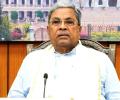
Karnataka Chief Minister Siddaramaiah has clarified his remarks on the Pahalgam terror attack, saying he did not call for no war with Pakistan, but emphasized that war should only be a last resort. His comments, which were played up by Pakistan media, have sparked criticism from the BJP, which accused him of acting like a "puppet" of an enemy nation.

Union Minister of State BL Verma expressed concern over the situation in Bangladesh and said the government is closely monitoring it. Addressing a Rozgar Mela in Jammu, he lauded the BSF for its role in safeguarding India's borders with Bangladesh, Myanmar, and Pakistan. He also responded to questions on the Samajwadi Party's controversial statement labelling the BJP government as a "Hindu terrorist organisation", the Congress's allegations of EVM fraud, and Rahul Gandhi's call for a caste census.

Temples across Uttar Pradesh were packed with devotees on Sunday for Ram Navami, with Chief Minister Yogi Adityanath leading prayers at the Gorakhnath Temple. Heavy crowds were witnessed at temples in Lucknow, Gorakhpur, and Varanasi, where security was heightened. In Gorakhpur, Adityanath performed the traditional kanya pujan ritual, while in Varanasi, a 51-foot statue of Lord Ram has become a major attraction. The festival was celebrated with enthusiastic fervor across the state.
 © 2026 Rediff.com - Advertise with us - Disclaimer - Privacy Policy - Sitemap - Feedback - About us - Terms of use - Grievances